
How Wet Soil Ploughing Can Damage Your Next Crop
How Wet Soil Ploughing Can Damage Your Next Crop
Wet soil cannot carry the weight of a tractor the way dry, workable soil can. Yet after monsoon rain, farmers are often under pressure to get back into the field quickly.
The surface looks dry. The rain has stopped. The next operation is already delayed.
So the tractor goes in.
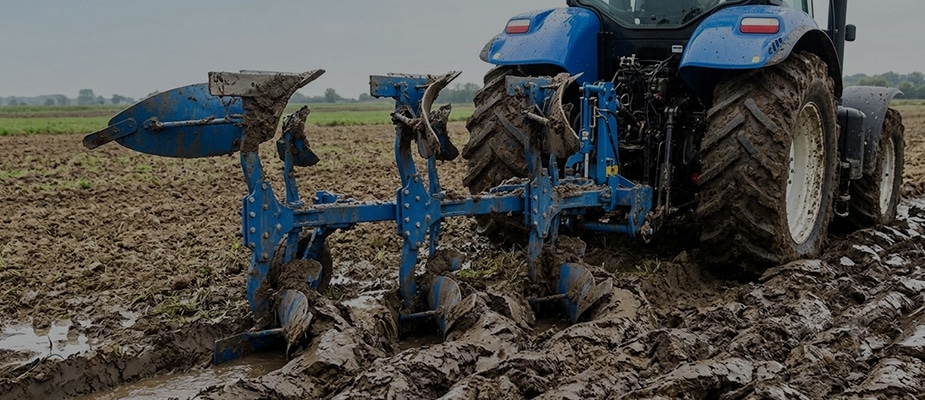
Even the best Hydraulic reversible plough cannot work properly if the soil underneath is still too wet. Enter too early, and the tractor can compact the soil, create deep wheel tracks, and leave behind a poor seedbed. That one decision can affect the soil for the rest of the season.
Wet Soil Compacts Easily
Wet soil loses most of its strength. The tractor tyre and other implements force the soil particles closer together, squeezing out the air pores between them, thus creating gaps that are usually left by air pores in the soil. Water flows through those pores. Plants require those pores as well.
Not all compaction occurs at the visible soil layer level since machinery can apply pressure on soil layers deeper than the usual ploughing depth. Various studies related to agricultural soil compaction have reported 10-20% reductions in yield under unfavorable conditions.
What surprises farmers even more is that according to field observations, about 70-80% of soil compaction occurs during the first operation, not the fifth one. Selecting appropriate equipment from a good plough manufacturer in India accounts for just half of the process; the rest is the right timing.
Wet Soil Does Not Plough Well Either
This is not the only problem. The soil must fracture as the plough moves through it. The wet soil adheres, smudges, and often creates clumps instead of providing a good soil seedbed.
The seeds may fail to get proper contact with the soil, leveling may become difficult, and one more pass might be necessary to break the clumps. It means more movement of the tractor, more consumption of diesel, and increased pressure on the same piece of soil.
When comparing agricultural equipment offered by the manufacturer of ploughs in India, the farmer should take into account not only tractor power, but also soil type, depth of tillage and typical operating conditions of the plough; the correct combination helps decrease the number of corrective passes.
Choosing a plough for your soil and tractor? Explore Shakti Agrotech’s range of hydraulic ploughs and compare models designed for different tractor capacities and field conditions.
The Damage Usually Appears Afterward
Compaction is easy to ignore because the field looks normal again once it dries. The crop tells a different story.
Roots find it harder to move through compacted soil, limiting access to water and nutrients, and rainwater enters compacted ground more slowly, increasing runoff risk. Come summer, a plant with restricted roots can’t explore deeper soil for moisture as effectively, meaning more irrigation and uneven growth.
Sugarcane Makes the Problem More Serious
Sugarcane needs good soil depth and a strong root system, and stays in the field far longer than most seasonal crops, so poor soil conditions can affect it for months.
Poor root development can affect tillering and water uptake, and compaction can continue affecting ratoon performance after the first harvest. For farmers choosing a reversible plough for sugarcane in Gujarat conditions, soil type, tractor power and timing matter as much as the plough itself.
Test the Soil, Not the Number of Days
Two days after rain may be enough in one field and completely wrong in another. Sandy soil drains faster; heavy clay and black cotton soil hold moisture much longer.
A simple hand test beats the calendar: take soil from the depth you plan to work and squeeze it firmly. If it feels sticky or forms a ribbon between your fingers, give the field more time. If it breaks and crumbles easily, it’s closer to workable.
The Plough Matters, But Timing Matters More
A good plough will not turn overly wet soil into one that can be worked on safely. It starts with the time you decide to go into the field; then comes the tool.
Once the soil is ready, a hydraulic reversible plough matched to your tractor and soil helps keep the desired working depth and get the field right in one pass, without extra corrective passes. That is where Shakti Agrotech helps.
Shakti Agrotech is an agricultural plough manufacturing company providing ploughs for various sizes of tractors and soils. It manufactures ploughs suitable for light soils as well as challenging soils like black cotton soil.
Not sure which plough matches your tractor and soil? Speak with the Shakti Agrotech team to find the right Hydraulic reversible plough for your field conditions before your next pass.
Give the Field the Time It Needs
Wet soil does not always look wet; that’s what makes the mistake so easy to make. Before taking the tractor back after rain, check below the surface. Five minutes spent testing the soil can prevent compaction that stays with the field for years, especially since most of that damage happens on the very first pass.
The season doesn’t begin when the rain stops. It begins when the soil is ready, and when it is, Shakti Agrotech’s Hydraulic Reversible Plough range is built to make that first pass count.
Explore Shakti Agrotech’s Hydraulic Reversible Plough range.